Killing Cancer with Quantum Mechanics


I'm certain that you directly interact with the subject of this post almost every day, or at least benefit from the things we can do with it. It cuts, it welds, it drills, it cleans. It's in fibre optic cables, barcode readers, computer mice and printers. You can't make OLED TVs without it and it reads and stores information on CDs, DVDs and BlueRay. It can correct vision, remove hair and tattoos and, yes, even kill cancer cells. The list goes on and on. Surely you know what I'm talking about by now. Say it with me: Light Amplification by Stimulated Emission of Radiation! Or, its common name, laser.
Who knew that a beam of light of a single colour travelling in only one direction could be so useful? Well, the people who invented it did. That’s why they built and operated the first one on May 16, 1960. Today the word ‘laser’ need not only refer to visible light, so technically the first one was built in 1953. It was called the maser (microwave amplification by stimulated emission of radiation) and, since it came first, lasers were initially called optical masers. This was a somewhat confusing name because it contained the contradiction “optical microwave”. Gordon Gould, a physicist whose work was instrumental to the development of lasers, wanted a different name for every frequency of electromagnetic radiation. If he got his way, we’d also have rasers, uvasers, xasers and gasers. He did not get his way (in more ways than one), and now we just call them all lasers.
We have the brilliant physicists and engineers at Bell Labs, Columbia University and Hughes Research Laboratories to thank for this world-changing technology. Due to them, people live longer, better lives. Laser-enabled weapons act counter to these benefits, of course, but let’s focus on the positives for now. My last post was about how satellite navigation, an integral feature of modern life, is made possible by the efforts of theoretical physicists 60 years prior to its inception, who were thinking about the nature of space and time. Well, just over 50 years before the creation of the maser, theorists began cooking up one of the greatest hits of 20th century physics, without which laser technology would not be possible: quantum mechanics.
The Ultraviolet Catastrophe
Before the exciting stuff like wave functions, superposition and entanglement entered the picture, quantum mechanics began life in a much more boring way. Despite the drama that the name ‘Ultraviolet Catastrophe’ conjures, it amounted to a much dryer question: What is the theoretical explanation for the spectral radiance of blackbody radiation?[1] Let’s break apart that jargon. A black body is an idealized object which absorbs all the electromagnetic radiation that hits it. At room temperature, it would look exactly as its name suggests. It would still be emitting light of every wavelength, but the amount it would give off (the spectral radiance) would change depending on the wavelength. For some physical approximation of a black body, we can measure the spectral radiance and obtain a graph like this one:
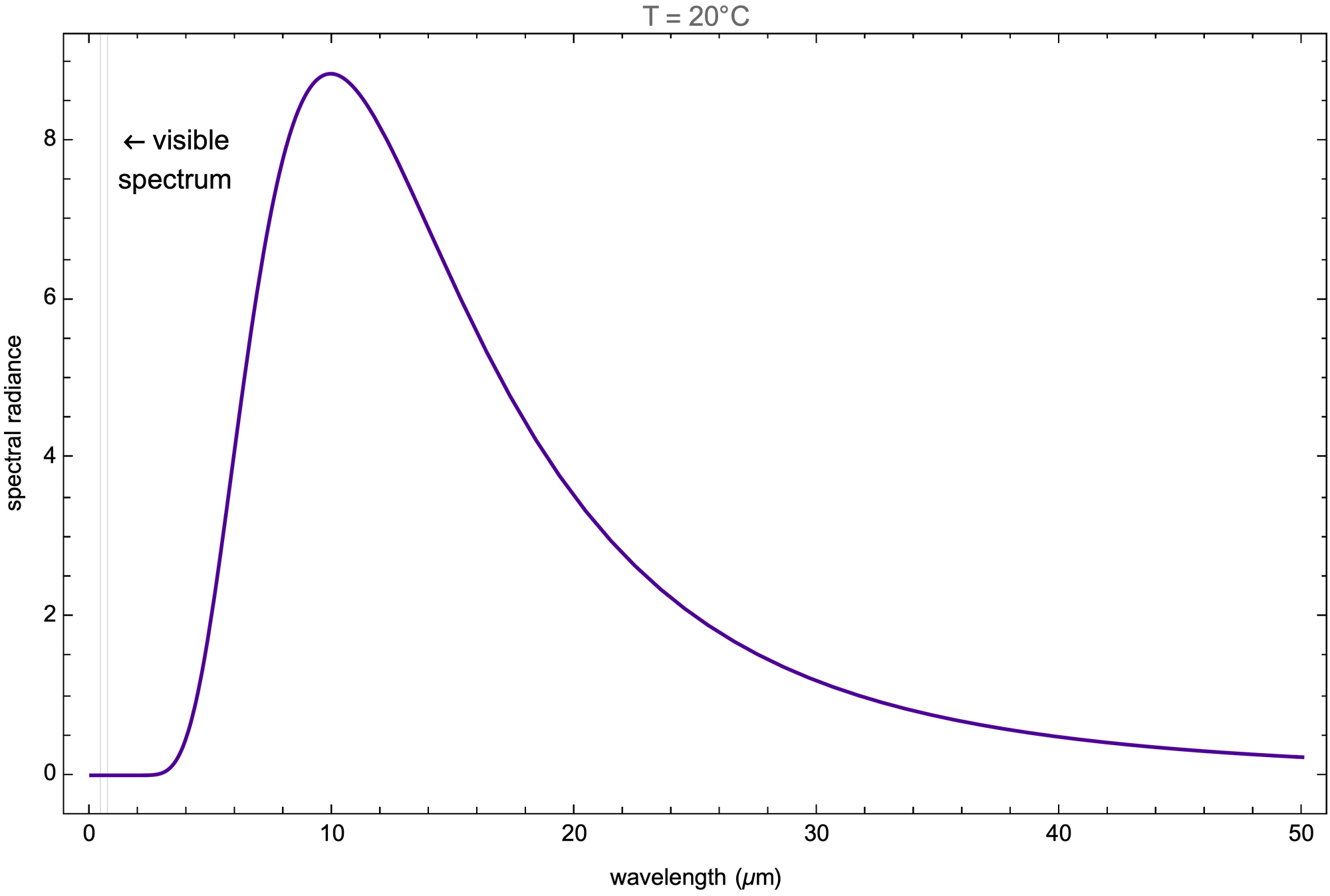
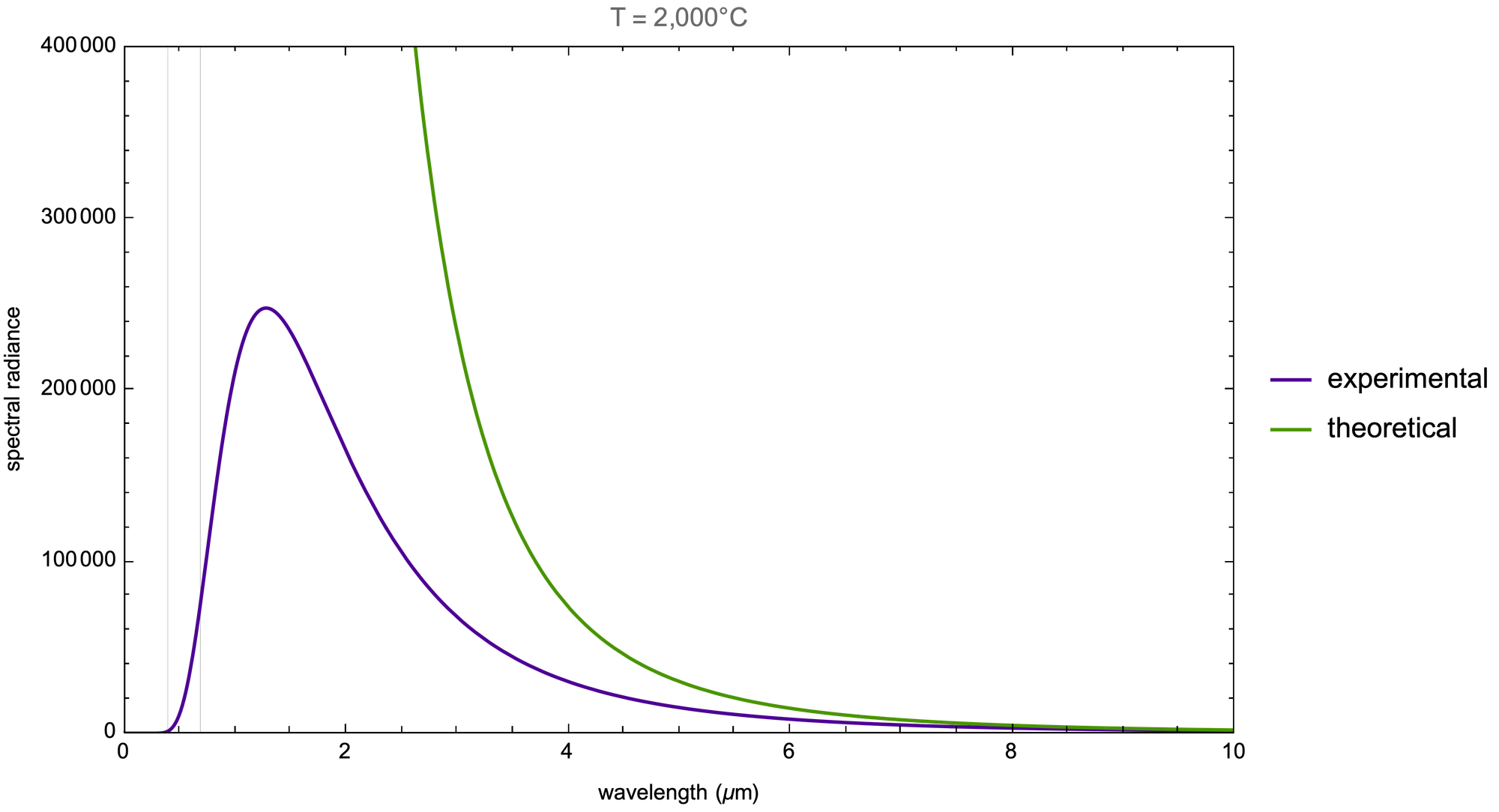
Get something hot enough and it will eventually glow. Two things will happen to the radiance curve above as we do so. First, its height will increase; you're supplying the black body with more energy, so the total amount of light it gives off will go up. Second, it will shift to the left; a greater proportion of the light it gives off will be more energetic, and thus will have a shorter wavelength. So far, so simple. What's catastrophic about this? Well, at the time, the theory which best described the spectral radiance of a black body, the Rayleigh-Jeans law, worked pretty well for longer wavelengths. However, for shorter wavelengths, it predicted a far greater spectral radiance than we observed. In fact, it predicted an infinite amount of light would be emitted as wavelengths grew ever shorter (see below). This was obviously wrong, but no one knew how to do any better.[2]
As often as I can, I like to remind people that scientists are not infallible logic machines who only hold true beliefs. For example, Max Planck was a German physicist who did not initially believe in atoms or the field of statistical physics. And yet, he resolved the Ultraviolet Catastrophe with remarkable creativity. He imagined that black body radiation came from a set of finitely many identical oscillating bodies. He then supposed that the frequency of each oscillating body could not vary continuously, but instead took discrete values. The energy \(E\) of each oscillating body was related to its frequency \(f\) by a new fundamental constant of nature \(h\) (Planck's constant), satisfying the equation \[E = hf\:.\] If we imagine that the electromagnetic radiation is coming from these bodies oscillating with discrete frequencies, and do some fancy statistical mechanics (which Planck begrudgingly had to use), then we obtain the Planck law, the correct description of black body radiation.
Planck did not imagine that his oscillating bodies corresponded to anything physical. To him, they were just convenient mathematical tools to obtain the correct answer. In particular, he thought that although the oscillating bodies were fixed to discrete frequencies, light in general could still propagate at any continuous frequency. Einstein thought otherwise and, in 1917, published a derivation of Planck's law based on a 'quantum theory of radiation'. In doing so, he unknowingly laid the theoretical foundation for lasers.
Stimulated Emission
Another natural phenomenon which was just as instrumental in the development of quantum mechanics as black body radiation is the stability of matter. Our best theoretical descriptions of atoms (for those who believed in them) predicted that all the matter in the Universe would immediately decay. Since 1897, we've known that when a charged particle accelerates it emits light. If taken literally, Rutherford's model of the atom, where a negatively charged electron orbits a positively charged nucleus, suggested that electrons would constantly give off radiation, losing energy as they did so, and eventually colliding with atomic nuclei. Clearly, they don't do that, but no one could figure out why.
Inspired by Planck's approach, Niels Bohr hypothesized that the electrons simply weren't allowed to take on any old orbit, but were fixed to a discrete set of "stationary orbits" which were determined by the charge of the nucleus. If they absorbed energy from light (or heat), they could move to a higher orbit, but only if the energy of the light, \(E = hf\), exactly matched the energy gap between the orbits. Conversely, electrons could move down to lower orbits by emitting light, and the frequency of that light would exactly correspond to the energy difference.
Do you see the connection that Einstein saw? Planck's oscillators are real; they are Bohr's atoms. When you heat up a black body, the atoms absorb this heat and transition to higher energy levels, then spontaneously drop down again, emitting a photon (a discrete packet of light) in the process. Einstein made the further prediction of stimulated emission. Consider shining light on an atom which has already been excited into a higher orbit. If the energy difference to the lower orbit matched the energy of the incoming light, then with some probability the electron will drop to the lower level, emitting a photon with identical frequency. The light has been amplified, since we've doubled the number of photons we started with.
This is basically everything you need to know to understand how a laser works. The setup varies somewhat, but here's one example. Get a bunch of atoms, placed between two mirrors, in thermal equilibrium. That means there are about as many photons being spontaneously emitted as there are being absorbed. Add a photon with exactly the right energy, and it will stimulate the emission of an identical photon, moving in the same direction, which will stimulate the emission of another, and so on, thereby achieving massive amplification. Give the now much more intense beam of light a way to escape and there you have it: a dangerous but super useful beam of light, amplified through the process of stimulated emission. Try not to shine it in your eyes...
Also, if you thought Ultraviolet Catastrophe would make a great name for your indie rock band's next album, I have bad news. ↩︎
For shorter wavelengths we had Wien's law, which can be obtained by invoking thermodynamics. However, it becomes less accurate for longer wavelengths; we still lacked a theoretical description which held for all wavelengths. ↩︎

